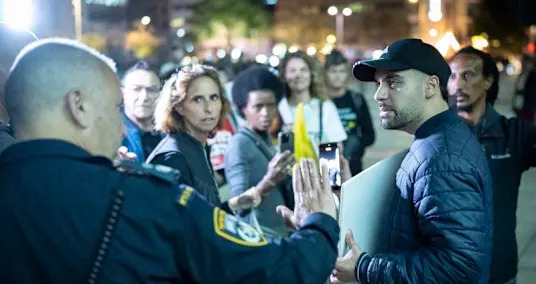
Protests took place in Tel Aviv, Jerusalem, Haifa, and Beersheba, as a survey found broad but uneven support among Jewish Israelis for Operation Roaring Lion.
Israel Police arrested 21 anti-war protesters Saturday night as demonstrations against the conflict with Iran expanded in multiple cities despite restrictions on public gatherings.
Protests took place in Tel Aviv, Jerusalem, Haifa, and Beersheba, with hundreds of participants reported in Tel Aviv and Jerusalem and about 100 in Haifa, marking the largest turnout since weekly demonstrations began. Authorities said 13 people were arrested in Tel Aviv and eight in Haifa.
Police said the gatherings were not approved under Home Front Command regulations that ban events with more than 50 people. Officials said the increase in turnout followed calls by groups opposing the government to protest despite the restrictions.
“During a situation assessment that took place at the scene with a Home Front Command representative… it was clarified that there was a real risk to human life and accordingly, Yarkon [precinct] police commander Tzachi Sharabi ordered the gathering to be dispersed,” police said.
Hadash-Ta’al chairman Ayman Odeh, an Arab lawmaker involved in the protests, criticized the police response, calling officers fascists “in the service of the government” and saying they were afraid of “the heroic citizens who went out, despite everything, to make their voice heard.”

Survey shows broad, uneven support for war
The demonstrations come as a March 2026 survey by the Israel Democracy Institute found broad but uneven support among Jewish Israelis for Operation Roaring Lion. Support was strongest on the Right at 87% and about half on the Left.
The survey also found that Jewish and Arab respondents largely agreed that Iran’s resilience has been stronger than expected. Most Jewish respondents said Israeli society could sustain the campaign for up to one month, while 28% said as long as needed. Arab respondents were less optimistic about how long the public could endure the conflict.
A majority of Jewish respondents said Prime Minister Benjamin Netanyahu’s decision was driven by security considerations, while most Arab respondents viewed it as political.
LATEST POSTS
- 1
 Step by step instructions to Protect Your Senior Condo for Ideal Wellbeing and Solace
 - 2I'm a woman who's into weightlifting. Was I man enough for the creatine-packed 'Man Cereal'?
- 3Rick Steves' Newest Guidebook Is A Fresh Perspective On Italy Spilling The Country's Secrets
- 4What loving-kindness meditation is and how to practice it in the new year
- 52024 Ferrari Roma With Just One Owner & 3,300 Miles For Sale At $...




- Partner of crime boss Steven Lyons arrested in Dubai
- Shipping: The Corridors of Trade and the Coming of Another Period
- Hundreds of Gazans evacuated from Strip for medical treatment - COGAT
- Northern lights chances rise for Christmas as space weather remains unsettled
- James Webb Space telescope spots 'big red dot' in the ancient universe: A ravenous supermassive black hole named 'BiRD'
- Astronomers discover never-before-seen celestial object: "Cloud 9"
- Find the Standards of Viable Refereeing: Settling Debates with Strategy
- Artemis 2 breaks humanity's all-time distance record during historic loop around the moon (video)
- Lily Allen 2026 'West End Girl' Tour: How to get tickets, prices, presale info and more