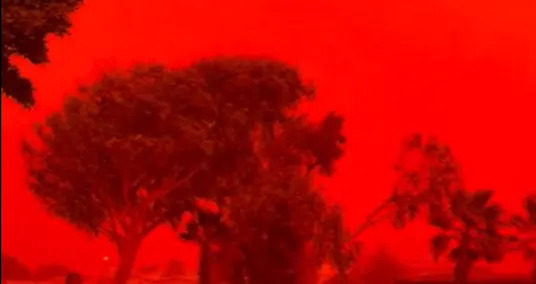
Australia’s skies turned blood red on Friday as Tropical Cyclone Narelle approached the west coast, with residents describing "apocalyptic" scenes and "the sky issuing a final warning”.
The colour change took place as the storm whipped iron-rich soil from northern Western Australia’s distinctive red landscape into the atmosphere, AccuWeather said.
The soil undergoes a weathering process of oxidation over millions of years, according to the US National Oceanic and Atmospheric Administration.
"In this type of environment, these rocks actually begin to rust," the agency explained. "As the rust expands, it weakens the rock and helps break it apart."
That process gives the dirt its reddish hue, with coloured dust scattered by the storm across Shark Bay, Denham and Karratha on the Pilbara coast.
Angus Hines, senior forecaster at the Bureau of Meteorology, told the ABC a thick layer of cloud deepened the effect considerably. Dust storms in the Pilbara and Gascoyne are common but they typically occur under blue skies where direct sunlight softens the colour of particles in the air. On Friday, dense clouds blocked that single light source entirely.
"When you have got the thick cloud cover, the light doesn't feel like it's coming from a single source," he said. "It feels like the light is evenly illuminating the ground, like a panel of lighting as opposed to one bright spotlight."
He described it as "the most striking example of that phenomenon that I've ever seen”.

The Shark Bay Caravan Park in Denham said the dust arrived gradually before engulfing the area entirely. "Incredibly eerie outside and everything is covered in dust," the park wrote on Facebook.
The dust cleared quickly once the cyclone's wind and rain arrived.
The phenomenon, known as mie scattering, occurs when sunlight hits large numbers of microscopic particles matching the wavelength for red light.
Similar scenes have been witnessed before. In 2019, fires along Australia's east coast turned daytime skies black and then blood red. And that same year wildfires in the central Sumatran province of Jambi produced a red sky over Indonesia.
Narelle was a rare triple-strike system. It made landfall first in far north Queensland, then crossed the Northern Territory before reaching Western Australia.
In Exmouth, roofs were torn from buildings and the marina was badly damaged. At least 30 pastoral properties were extensively damaged and a banana grower in Carnarvon said 80 per cent of his crop had been destroyed.
The storm also forced a halt to production at Australia's two biggest liquefied natural gas plants, run by Chevron and Woodside, adding to pressure on global energy supplies already strained by the war in the Middle East.
The cyclone was downgraded to a subtropical system on Saturday, although authorities warned of continued heavy rainfall and strong winds.
Western Australia premier Roger Cook announced one-off payments of up to $2,000 for damaged homes and $4,000 for destroyed ones, as a lengthy clean-up got under way.
LATEST POSTS
- 1
 Home Mechanization Frameworks for Brilliant Residing
 - 2The teen queen bee of 'Laguna Beach' is now a 'cringey' mom
- 3Rebecca Gayheart on her 'very complicated' relationship with Eric Dane: 'I am always going to want the best for him'
- 4Netanyahu on Gush Etzion terror attack: 'We will complete war on all fronts'
- 5IDF says up to 90% of Iran’s weapons industry could be hit within days




- Extreme Manual for Purchasing Your Next Truck
- Scientists may be overestimating the amount of microplastics in the environment – and the culprit is lab gloves
- The Response to Fake General Knowledge: Investigating the Eventual fate of artificial intelligence
- True serenity: Investigating Emotional well-being and the Advantages of Contemplation
- Sixteen Kenyans missing in Russia after army recruitment
- Opening Potential: Self-awareness and Long lasting Learning
- Help Your Efficiency: 10 Authoritative Apparatuses to Attempt
- Astronauts welcome arrival of new crewmates | On the International Space Station this week Nov. 24-28, 2025
- Find the Interesting Universe of Computerized reasoning: the Capability of man-made intelligence