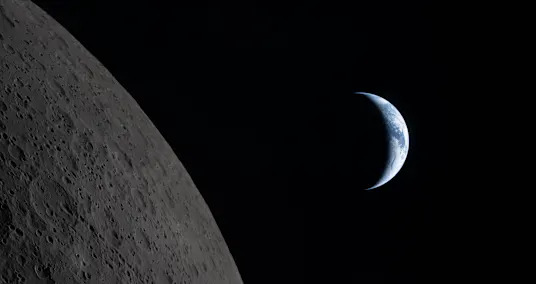
NASA has released the first images taken by the Artemis II crew during their historic trip around the far side of the moon.
The four astronauts — NASA commander Reid Wiseman, pilot Victor Glover, mission specialist Christina Koch and Canadian Space Agency mission specialist Jeremy Hansen — spent Monday’s seven-hour lunar flyby taking photos and making observations from the Orion spacecraft, which they named Integrity.
Among the stunning new images uploaded by NASA on Tuesday was a photo of “Earthset,” which was captured through the Orion capsule’s window at 6:41 p.m. ET, according to NASA.
"A muted blue Earth with bright white clouds sets behind the cratered lunar surface," the photo caption reads. "The dark portion of Earth is experiencing nighttime. On Earth’s day side, swirling clouds are visible over the Australia and Oceania region.”
Visible in the foreground is the moon, with the Ohm crater’s “terraced edges and a flat floor interrupted by central peaks,” per NASA’s description.

The crew also captured “Earthrise,” recreating the iconic photo taken during the Apollo 8 mission in 1968.

Also included in the new batch of images is a view of the solar eclipse that the crew experienced near the end of the flyby.

The astronauts donned eclipse viewers to protect their eyes during the nearly hour-long celestial event. But they still struggled to put into words what they were witnessing.

“Humans probably have not evolved to see what we're seeing," Glover told mission control. "It is truly hard to describe.”

Other photos captured close-up views of the lunar surface, including little-seen craters and basins from the vantage point of the crew, which at one point came within about 4,000 miles of the moon.
During Monday’s flyby, the Artemis II set a new record for the farthest distance from Earth traveled by humans — 252,756 miles, surpassing the previous mark set by Apollo 13 in 1970.


LATEST POSTS
- 1
 Shredded cheese sold in dozens of states recalled due to potential for metal fragment contamination
 - 2Electric discovery on Mars! Scientists find tiny lightning bolts coming from Red Planet dust clouds
- 3Journalist reported killed in the Gaza Strip
- 4She was moments away from giving birth. The hospital discharged her
- 5How HIV/AIDS got its name − the words Americans used for the crisis were steeped in science, stigma and religious language


- Iranian rockets hit Tel Aviv area, injuring six
- The 15 Best Business visionaries Under 40
- 10 Moves toward Start Your Own Effective Business
- Vote in favor of Your #1 Climbing boots Now
- Step by step instructions to Shield Your Wellbeing Around 5G Pinnacles\
- Rediscovering Imagination in Adulthood: Individual Creative Excursions
- Netflix’s Price Hikes Just Got Rejected by an Italian Court. Here’s Why It Matters Everywhere
- From invasive species tracking to water security – what’s lost with federal funding cuts at US Climate Adaptation Science Centers
- Figure out How to Put resources into Lab Precious stones