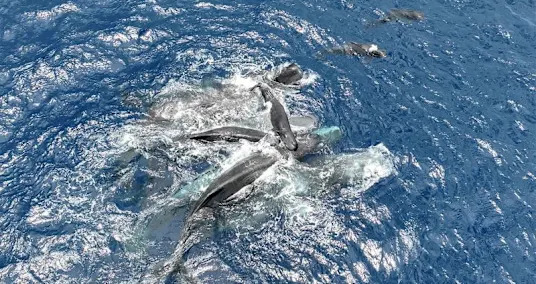
March 26 (Reuters) - When a mother sperm whale gives birth, it is a remarkable team effort. Marine biologists have documented how multiple adult female sperm whales surrounded the mother as the whale gave birth, then collectively hoisted the calf out of the water as the newborn took its first breaths.
With observations in the eastern Caribbean off Dominica's coast, the researchers offered the most detailed account to date of the birth process in sperm whales or any cetacean - the group that includes whales, dolphins and porpoises - in the wild. Sperm whales are the largest of the toothed whales and possess the biggest brain, about 18 pounds (8 kg), of any animal.
The researchers witnessed an episode of highly coordinated cooperation in which 11 sperm whales - 10 females including the mother and a single adolescent male in a peripheral role - were present for the birth and helped ensure the calf's safety.
Using drone video, underwater audio and shipboard photography, scientists with the Project CETI research organization documented the event on July 8, 2023. The birth process lasted about 34 minutes, from flukes emerging from the mother to the calf's delivery.
Multiple adult females surrounded the mother, a whale nearly 33 feet (10 meters) long. Sets of whales then took turns in physically supporting and lifting the newborn to the ocean surface.
The findings were published on Thursday in two studies in the journals Science and Scientific Reports.
"We observed a highly cooperative period of caregiving right after birth. The whales formed a very tight cluster around the newborn, repeatedly touched it, supported it with their bodies and took turns lifting and pushing it toward the surface. The lifting behavior continued for several hours," said Alaa Maalouf, Project CETI's robotics and machine learning team member and lead author of one of the studies.
As an air-breathing marine mammal, it is vital that a calf comes to the surface to breathe shortly after birth. This calf was lifted to the surface within a minute of delivery.
"Birth is a high-risk moment for sperm whales because newborns are initially immobile and helpless - much like humans - and newborns require immediate assistance from others to reach the surface for their first breath to prevent drowning," said marine biologist and research co-author David Gruber, Project CETI's president.
Coordinated lifting behavior previously was documented in three other toothed whales - killer whales, false killer whales and belugas - and may date back to when the last common ancestor of these species lived more than 30 million years ago, the researchers said.
Vocalizations made by the whales shifted at critical moments, including the onset of labor and interaction with short-finned pilot whales that arrived on the scene. Several hours after the delivery, the sperm whales dispersed into smaller and more typical foraging groups.
The sperm whales that cooperated during the birth came from two normally separate family groups.
"What makes this especially striking is that the support crossed kinship lines. Groups that are often more separate during normal foraging appeared to come together during birth, suggesting that sperm whale society may be built on more than close family bonds alone. In addition, the scale and structure of this cooperation point to a high degree of social and cognitive sophistication," Maalouf said.
Like other marine mammals, sperm whales are highly social animals. These whales, with the largest males reaching about 60 feet (18 meters) long, are deep divers, feeding on prey including giant squid. The last scientific record of a sperm whale birth came in 1986, limited to written observations.
Sperm whales maintain complex social systems in which stable matrilineal family units of perhaps 10 to 12 individuals cooperate in foraging and caregiving.
"Male sperm whales leave their natal units in their early teens. The grandmother, mothers and daughters will live together for life as a unit," said research co-author Shane Gero, Project CETI's lead biologist. "Females live in these units to cooperatively defend and raise the calves, while mature males live mostly solitary lives roaming between oceans in search of mates."
Gero called it "a fascinating surprise" that the adolescent male attended this birth event.
"Sperm whales specifically share traits strikingly similar to humans. Sperm whales have the largest brains of any species and have higher-level functions such as conscious thought and future planning, as well as speech and feelings of compassion, love, suffering and intuition," Gruber said.
(Reporting by Will Dunham in Washington, Editing by Rosalba O'Brien)
LATEST POSTS
- 1
 Paris Agreement target off the table, report says
 - 2The most effective method to Refresh the Infotainment Framework in the Volvo XC40
- 3Evidence of lost baptismal rite stage uncovered in Byzantine era cathedral near Sea of Galilee
- 4Hamas demanded displaced Gazans pay rent on beach tents amid torrential downpour, IDF reveals
- 5Kids who get 2-month vaccines on time 7 times more likely to receive MMR shot: Study





- A definitive Manual for the 5 Off-road Bicycles Available
- South Carolina confirms 124 new measles cases as outbreak on the Arizona-Utah line grows
- UN panel says Israel operating 'de facto policy of torture'
- Grasping the Qualifications Among Separation and Dissolution
- New dinosaur tracks in Italy illustrate herds moving in unison
- Vote in favor of the bloom plan that adds a bit of excellence to your life!
- 6 Novice Cameras for 2024: Ideal for New Picture takers
- War in Iran could exacerbate German housing crisis, minister warns
- The Best 15 Applications for Efficiency and Association