When you buy through links on our articles, Future and its syndication partners may earn a commission.

The sungrazing comet C/2026 A1 (MAPS) has been causing a stir in recent months as it brightened during its headlong rush towards the sun, which culminates in a high stakes close approach known to astronomers as perihelion on April 4. Here's how you can watch its final do-or-die approach for yourself through the technological eye of a sungazing spacecraft.
C/2026 A1 (MAPS) is thought to belong to the Kreutz family of comets — enigmatic solar system wanderers that are thought to have a shared progenitor and whose orbits take them perilously close to our parent star.
At perihelion, C/2026 A1 (MAPS) is expected to pass just 101,100 miles (162,700 km) from the sun's photosphere — a passage that could either spell its doom as volatiles buried beneath its surface vaporize and undermine its integrity, or may even see it shine bright enough to appear in the daytime sky.
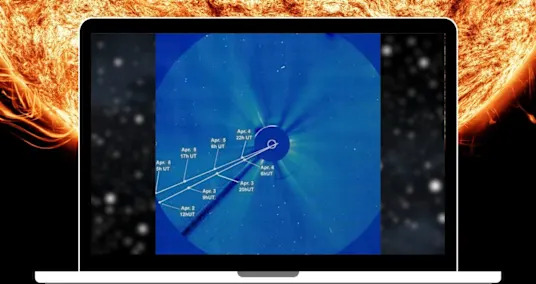
Either way, you may be able to spot the wandering solar system body as it careens towards the sun in imagery captured by the Large Angle Spectrometric Coronagraphy (LASCO) mounted on the joint ESA/NASA Solar and Heliospheric Observatory.

LASCO was designed to take detailed images of the sun's atmosphere by blocking out the light coming directly from its surface. Each of SOHO's "C3'" images captures a field of view 32 times the diameter of the sun, revealing how material ejected from its surface interacts with the space environment and, occasionally, detecting the presence of interlopers, such as C/2026 A1 (MAPS).
Space.com columnist Joe Rao forecast that comet C/2026 A1 (MAPS) will enter the LASCO instrument's field of view from 8:00 a.m. EDT (1200 GMT) on April 2 through to 1:00 a.m. EDT (0500 GMT) on April 6. It will briefly disappear as it passes into the blind spot created by the instrument's occulter disk for the four hours surrounding periohelion, before emerging back into LASCO's field of view, assuming it survives the close brush with our parent star.
LATEST POSTS
- 1
 2025 Yachting Editors' Choice Awards: Yachts
 - 2Windows to the Previous: An Excursion Through the World's Notable Engineering
- 3Scientists reveal earliest evidence for shifting of Earth’s crust
- 4Argentina reportedly delaying embassy move over Israeli company's oil project near Falklands
- 5Experience Arranging: Planning for Epic Excursions




- Most loved Solace Food: What's Your Definitive Comfortable Dinner?
- NATO needs Ukraine's 'adaptation DNA' and an 'HOV lane' for new war tech, top commander says
- Building an Individual Brand: Illustrations from Powerhouses
- Humpback whale freed by rescuers in Baltic Sea has become stranded again
- Vote In favor of Your Favored Video Conferencing Administration
- Mussolini's summer villa on Adriatic coast sold for €1.2 million
- Artemis 2 astronauts reveal adorable zero-g indicator 'Rise' | Space photo of the day for March 31, 2026
- Everything you should know before booking a trip to Spain
- Earth’s magnetic field protects life on Earth from radiation, but it can move, and the magnetic poles can even flip